Grief as a house
The Sky Is EverywhereGrief as a house is the metaphor Lennie Walker uses to make bereavement tangible: after Bailey Walker’s death, familiar spaces no longer feel steady or protective, and sorrow becomes an architecture she must inhabit. The image develops from a poem into a way of understanding how loss alters family life, draws the living toward one another, and persists without canceling the possibility of a future.
The House and Its Unsettled Rooms
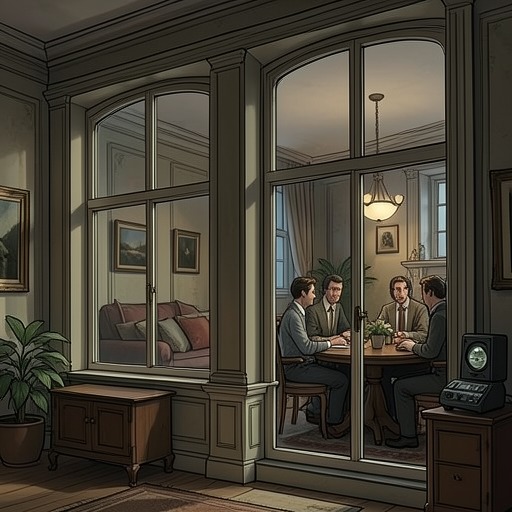
In chapter 10, Lennie watches Joe Fontaine play guitar and recognizes that beneath her sadness she wants to fly. The poem that follows gives that feeling a structure. Its chairs can no longer hold their occupants, its mirrors cannot return a dependable reflection, and its walls cannot contain what is happening inside. These failures make grief more than an emotion: it changes the ordinary functions by which a home offers support, recognition, and boundaries.
The poem’s house is also unstable. It disappears when someone approaches the door or rings the bell, then sinks into the ground while everyone sleeps. Rather than providing shelter, it eludes those who might seek it and leaves its inhabitants without protection. The image captures the disorienting alternation between public contact and private pain: the outside world can intrude, but its arrival does not make grief manageable or visible in any reliable way.
The poem sharpens this insecurity through the sisters’ altered relation to time. Lennie, the younger sister, will grow older than Bailey, who died at nineteen. The house therefore holds not only absence but an irreversible change in their expected order. Its rooms cannot keep the sisters together, and its walls cannot prevent Lennie from continuing through years Bailey will not experience.
Grief as a Shared Architecture
The metaphor becomes relational when Lennie and Toby Shaw meet at Flying Man’s. Toby tells her that Bailey had wanted her wedding ceremony there, followed by a jump into the pool. As he describes the celebration Bailey imagined, Lennie pictures her in a bright orange dress, laughing and leading the party back toward the house. The happiness in this imagined scene makes the loss newly present: Lennie begins to cry, Toby’s tears fall onto her face, and they kiss again.
Lennie’s accompanying poem does not suggest that Toby can repair the house or restore what it contains. Instead, it describes the relief of having someone beside her who knows its architecture and can accompany her from one sorrowful room to another. Their intimacy grows from shared knowledge of Bailey and from the understanding that the other is grieving too. The companionship makes the structure less frightening and less lonely, though it does not make it whole.
That distinction matters elsewhere in Lennie’s bereavement. In the summer after Bailey’s death, Gram follows her with tea, trying to resume a ritual they once shared, while Lennie withdraws and pretends to read. Gram also spends long periods in the shower, where Lennie understands that she is crying out of sight, though the family can hear. Grief disrupts the household’s old routines and makes even care difficult to accept. The house metaphor gives these different responses a common shape without implying that the family experiences sorrow in the same way.
Absence, Family Memory, and Discovery
The image also resonates with the family’s older wound: Paige Walker’s prolonged absence. Gram had explained Paige’s departure through a family tendency toward restlessness, describing generations of women who left and eventually returned. That account made absence part of a family pattern, but it could not answer what Paige’s leaving meant to her daughters or why it had happened.
When Lennie finds Gram’s carefully preserved letters to Paige in an attic box, the discovery changes the emotional history held within the family home. The box contains years of sealed letters addressed to Paige. Lennie’s reading reveals ordinary details she has not known about her mother, including her love of lilacs and the pesto she made with walnuts. These domestic particulars make Paige feel more like a real mother to Lennie, intensifying both longing and the question of how such a mother could leave her children.
Gram later recalls the night Paige came home wearing a long green dress, with lilacs filling the kitchen. Paige had arrived with a one-way plane ticket and told Gram she did not feel able to be a mother. Gram tried to persuade her to stay and help raise the girls, then, in anger and fear, told her never to return. Lennie tells Gram that Paige’s departure and failure to come back were Paige’s choices, not Gram’s fault. Gram’s response suggests the release of a guilt she has carried for sixteen years. In this family, the house of grief is built from more than Bailey’s death: it also contains the sealed history of Paige’s absence and the blame Gram kept within herself.
A House That Remains
The metaphor does not promise that grief will vanish once it has been understood or shared. Near the end, Lennie recognizes that Bailey will die again for her throughout her life, because each return of grief comes from continuing love. She imagines the fact of having a future beside the fact that Bailey does not, step for step and breath for breath. Grief becomes part of the person who survives rather than a temporary structure that can simply be left behind.
The ending gives that persistence a movement beyond the house. After working alongside Gram, Lennie runs through alternating patches of sunlight and shade on her way to the cemetery. The fabric of death that has clung to her for months begins to loosen, and she experiences a moment of happiness directed toward the next day and the years beyond it. At Bailey’s grave, she sits beside the stone, touches Bailey’s name and nineteen years, and reads the words she wrote for her sister. The visit does not undo the loss; it places memory within a life still moving forward.
Grief as a house thus joins two truths rather than resolving one into the other. Bereavement remains an unstable and sometimes unprotective place, shaped by vanished futures and family secrets. Yet Lennie can be accompanied through it, can discover what its rooms have concealed, and can continue living without treating new happiness as a betrayal of Bailey. The house does not disappear for good. Its meaning changes as Lennie learns that grief endures because love does too.